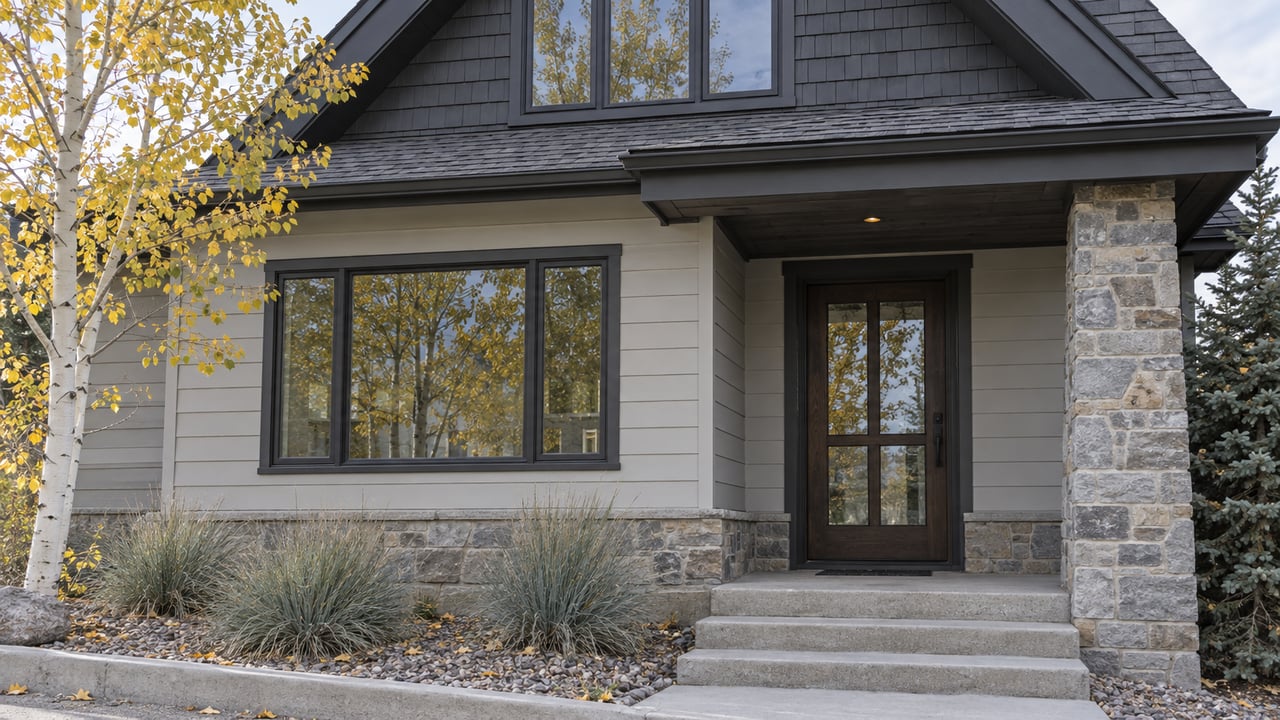
"There are no price appreciation caps, there are no income limits and there are no prohibitions from owning other real estate."
The Vail Daily quoted Michael O'Connor of Triumph Development West describing the deed restriction that governs Timber Ridge Village, the 302-unit workforce housing project rising along North Frontage Road. It sounds like a straightforward deal: buy a home, and the property behaves like any other asset you own. No ceiling on what it can be worth someday.
Drive a few minutes further into West Vail and a different rulebook applies. At Chamonix Vail, the 32-home neighborhood off Chamonix Road that's been selling through the Town of Vail's lottery since 2018, a unit currently up for resale is capped at $625,350, with future appreciation limited to 1.5 percent a year plus any approved capital improvements. Same town. Same general submarket. Two completely different financial instruments, both filed under the same word: deed-restricted.
If you're buying, selling, or trying to price a home anywhere near either of these developments, that distinction is not a footnote. It's the whole story.
Two Restrictions, Not One
West Vail has been absorbing deed-restricted housing at a pace unusual even for a resort valley that treats employee housing as infrastructure. What gets lost in the count is that these units split into two structurally different categories, and they don't behave the same way over time.
| Resident-Occupied (uncapped) | Price-Capped | |
|---|---|---|
| Example | Timber Ridge Village | Chamonix Vail |
| What's restricted | Who can live there | Who can live there, plus the maximum resale price |
| Appreciation | Follows the open market | Capped |
| Initial pricing (Timber Ridge) | $408,102 to $1,054,339 at first sale | Not applicable |
| Administered by | Triumph Development West / Town of Vail | Town of Vail Housing Department |
Timber Ridge units sold in that first category between roughly $408,000 and just over a million dollars, a range that mirrors free-market West Vail pricing closely enough that a first-time buyer touring both could reasonably confuse them. The Town of Vail confirmed sales were nearing 75 percent of the 302 units by last September, with more than 100 individual buyers and over 40 local businesses under contract. But because there's no appreciation cap, a Timber Ridge resale ten years from now could plausibly track close to market value.
A Chamonix Vail resale can't do that. It's mathematically locked to a formula that has nothing to do with what the surrounding neighborhood is doing. Two homes, similar square footage, similar proximity to West Vail's shops, and only one of them is actually telling you anything about market direction.
Why the Comp Doesn't Travel
This matters most at the appraisal desk. If a lender, appraiser, or buyer's agent pulls a nearby deed-restricted sale as a comparable and doesn't first confirm which category it falls into, the number they're working with may be structurally incapable of reflecting value. A Chamonix Vail sale at $625,350 isn't a soft market signal. It's a price formula doing exactly what it was built to do, regardless of what free-market inventory two streets over is fetching.
The Timber Ridge units carry less of that distortion risk today simply because they're new to the resale pipeline. Give it a decade and that will change too, but for now the practical takeaway is the same either way: before treating any deed-restricted sale in West Vail as market evidence, find out which of the two regimes it lives under. One is a real if imperfect data point. The other isn't a data point at all.
The New Subsidy Has a Ceiling
In April, Housing Eagle County and the Town of Vail launched Good Deeds Vail, a program that takes the price-capped model. Here's how it works: according to Eagle County, the town and county each contribute up to 15 percent of the purchase price, for a combined buy-down of up to 30 percent, capped at $375,000. In exchange, the home gets a price-capped restriction, with future resale appreciation limited to somewhere between 0 and 3 percent simple interest a year.
The program is administered through the Valley Home Store. It only applies to homes priced at $1,250,000 or below.
Why $1.25 Million Points at West Vail, Not the Village
That price ceiling is the part worth sitting with. As of late September 2026, active residential listings across Vail carried a median list price near $2,995,000, according to MLS-sourced figures compiled from the Vail Board of REALTORS. A separate estimate of average home value across Vail, covering the trailing twelve months, put the figure closer to $1,762,792, up 4.4 percent year over year. That gap between average value and median list price is itself informative: it means the town's for-sale inventory skews expensive relative to its broader housing stock, and the cheaper end of that stock is disproportionately concentrated in West Vail's Sandstone and Lionsridge subdivisions.
A program capped at $1.25 million isn't calibrated to Vail Village. It's calibrated to exactly the kind of condo and townhome inventory that defines West Vail. That's not a coincidence worth reading too much into as policy intent, but it is a fact worth reading clearly as market mechanics: the buyer pool for West Vail's free-market homes under $1.25 million just gained access to as much as $375,000 in matched subsidy, provided they're willing to accept a permanent price cap on the home going forward.
What This Means If You're Transacting Here Now
If you own a free-market home in West Vail priced under $1.25 million, your buyer pool as of this fall includes a segment that wasn't there a year ago: local employees who can now bring meaningfully more purchasing power to the table than their income alone would suggest, because the buy-down applies at closing. You don't need to do anything differently to reach them. They'll qualify on their end, working with the Valley Home Store as program administrator. What's worth understanding before you accept an offer from a Good Deeds Vail buyer is that the home leaves the free-market pool.
If you're buying and comparing a Timber Ridge unit, a Chamonix Vail resale, and a straight free-market West Vail condo side by side, price per square foot alone won't tell you which one is the better long-term hold. The occupancy requirement, the appreciation formula, and the resale approval process differ enough between all three that the comparison has to happen at the deed level, not just the listing sheet.
Frequently Asked Questions
Does a deed-restricted sale near my home affect my free-market appraisal? It can, but only if the appraiser fails to distinguish between the two restriction types. A price-capped sale like a Chamonix Vail resale isn't a valid comparable for a free-market home regardless of proximity or square footage, because its price is set by formula rather than by the market. A resident-occupied sale with no appreciation cap, like an early Timber Ridge resale, carries more relevance, though it's still worth flagging to your appraiser or lender directly rather than assuming they'll catch the distinction on their own.
If I'm selling a West Vail home under $1.25 million, will Good Deeds Vail buyers show up automatically? Buyers apply through the Valley Home Store on their end, so there's no separate listing step for a seller. What changes is the composition of your buyer pool and the fact that any offer coming through the program will include a deed restriction.
Deed restrictions are becoming a permanent feature of how West Vail transacts, not a side note to it. Understanding which version you're looking at, before you write an offer or accept one, is the kind of detail that separates a clean closing from a renegotiated one. If you're weighing a purchase or a sale anywhere in West Vail and want the deed language read correctly before you're under contract, Patrick H. Scanlan offers a confidential market strategy consultation built around exactly this kind of transaction detail.
This article is general information, not legal, tax or financial advice. Consult a qualified professional about your situation.