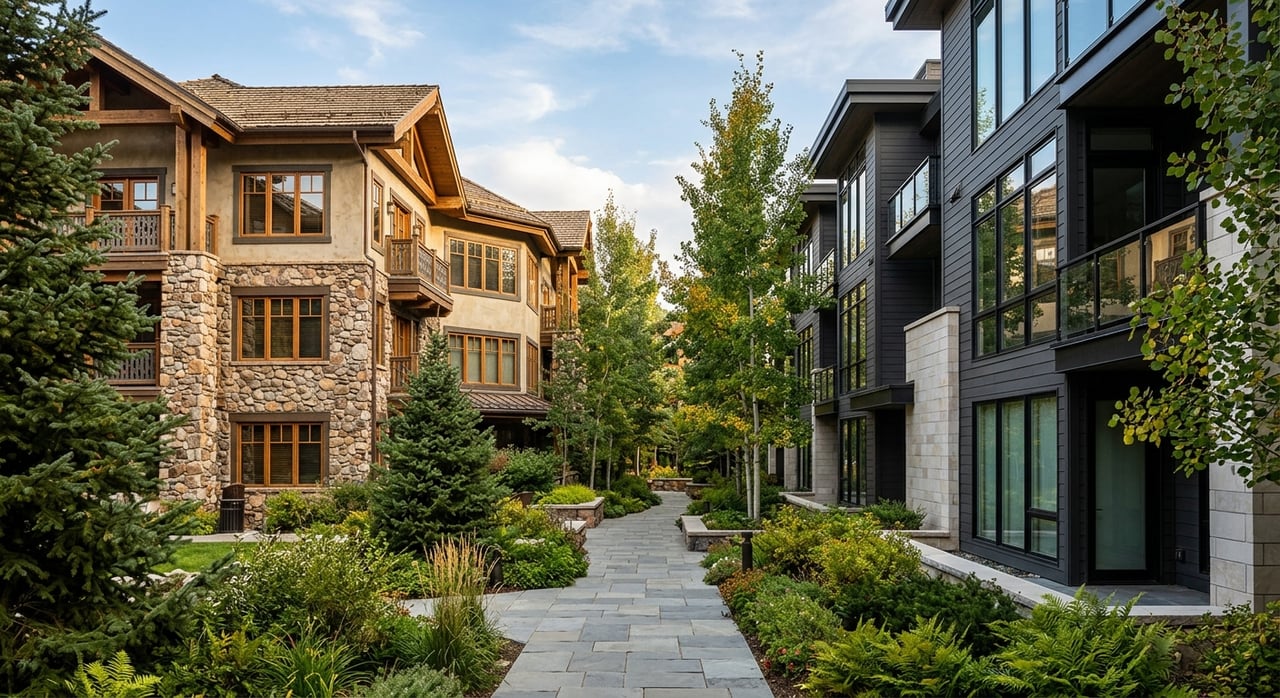
If you are looking at property in Vail Village, age alone will not tell you much. A 1960s or 1970s building may offer an iconic location and real character, while a newer residence may deliver a more turnkey layout and deeper service package. If you want to compare legacy and newer buildings in a practical way, this guide will help you focus on what actually matters in Vail Village. Let’s dive in.
Vail Village Has Several Building Eras
Vail Village is a compact, pedestrian-oriented core known for cobblestone streets and Bavarian-inspired architecture. Many buildings in the village were originally developed by Vail’s founders in the early 1960s, so a “legacy” building here often means 1960s to 1970s construction rather than centuries-old historic stock.
The village also includes a mix of condos, hotels, and private homes. That mix matters because ownership structure, service levels, and unit layouts can vary widely from one building to the next.
Founder-era buildings
Several well-known properties trace back to the earliest years of Vail. The Lodge at Vail was the first hotel built in Vail, Christiania Lodge was built in 1963, and the Red Lion building also opened in 1963.
These properties are part of the village’s original fabric. For many buyers, that creates a strong sense of place that newer product cannot easily replicate.
Expansion-era buildings
The next wave includes properties from the 1970s through the 1990s. Mountain Haus was built in 1970 and later renovated in 2013, while Austria Haus opened in 1998.
This era often blends original village charm with later updates. In practice, that can mean more variation in unit style, floor plan, and building systems.
Newer infill buildings
More recent village-core development is limited but notable. Four Seasons Resort and Residences Vail opened in December 2010, Solaris Residences had its grand opening in November 2011, and Altus Vail describes itself as one of the most significant new village projects in more than ten years.
That limited pipeline is important. In Vail Village, newer inventory tends to be episodic rather than constant.
Legacy Buildings Often Offer More Character
Older Vail Village buildings tend to be more individualized. Many were built in phases, expanded over time, or renovated repeatedly, so the result is often a less standardized ownership experience.
That can be a positive if you value character and a specific village feel. It can also mean you need to look more closely at the actual unit, not just the building name.
Layouts can vary significantly
The Lodge at Vail includes 165 rooms and suites, with 46 suites offering one-, two-, or three-bedroom configurations, along with wood-burning fireplaces and private walk-out balconies. Christiania at Vail began as a lodge and later added condos in the 1970s. Mountain Haus ranges from hotel-style accommodations to five-bedroom units.
That range shows why legacy product should not be treated as one category. Some buildings are room-based, some operate as condo-hotel hybrids, and some include larger residences added in later phases.
Renovation history matters
Many older village buildings have been updated over time instead of replaced. Christiania notes multiple renovation cycles, Mountain Haus was renovated in 2013, and Sitzmark was recently refreshed by new ownership in 2024.
In Sitzmark’s case, the refresh included adding air conditioning to a roughly 50-year-old building. For a buyer, that is a good example of why modernization status can matter more than original construction date.
Newer Buildings Often Feel More Turnkey
Newer Vail Village residences typically feel more consistent in layout and finish. They were generally designed with more deliberate open-plan living, larger kitchens, and a stronger emphasis on immediate usability.
If you want a cleaner decision path with less guesswork about updates, newer buildings may be the easier fit.
Residence-oriented floor plans
Solaris Residences ranges from studios to four-bedroom-plus-den homes, with residences as large as 6,500 square feet. Four Seasons Resort and Residences Vail includes 23 private residences and 6 Residence Club vacation condominiums.
These properties emphasize contemporary alpine design, large windows, and balconies or terraces. Compared with many early village buildings, they tend to offer more predictable layout logic and more uniform finish packages.
Service-heavy amenity packages
Newer buildings also tend to lean into full-service convenience. Solaris offers a 24-hour front desk, concierge service, covered parking, an indoor pool, hot tub, fitness center, spa, on-site restaurant, personal assistants, ski valet, and in-residence features such as fireplaces and laundry machines.
Its broader amenity package also includes bowling, a cinema, and climate-controlled wine storage. Four Seasons adds a year-round heated pool with two whirlpools, an open-air fireplace, and resort-style service.
Amenities Are Not Just About Age
It is easy to assume older buildings have fewer amenities, but that is not always true in Vail Village. The difference is often whether amenities were built in from day one or added later through renovations and operational upgrades.
That distinction can affect both convenience and long-term maintenance planning.
Legacy buildings can still compete well
The Lodge at Vail offers an outdoor pool, two hot tubs, spa access, a 24-hour fitness center, ski valet, valet parking, a concierge desk, and seasonal room service. Mountain Haus includes indoor and outdoor hot tubs, an outdoor heated pool, steam showers, saunas, and a renovated fitness center.
So while older buildings may have started with simpler offerings, many now provide substantial amenity packages. The practical question is how seamlessly those amenities fit the building and ownership model today.
Newer buildings often feel more integrated
In newer product, amenities tend to feel more cohesive because they were part of the original concept. That can create a smoother day-to-day ownership experience, especially if you are a second-home buyer who wants arrival, parking, storage, and concierge services to feel straightforward.
For remote owners, that ease can be especially valuable. A building with stronger built-in service layers may reduce friction when you are not in town full-time.
Location Inside the Village Still Matters Most
In a compact pedestrian core like Vail Village, exact placement can shape value as much as building age. A legacy building near Gondola One or the Covered Bridge may outperform expectations simply because the walk pattern is so convenient.
That is why a broad “old versus new” comparison can miss the point. You want to evaluate the building’s specific block, access pattern, and how that fits the way you plan to use the property.
Walkability changes the equation
Because the village is small and highly walkable, even short differences in route can matter. Ski access, restaurant access, and how quickly you can move through the core may influence your daily experience more than whether a building was completed in 1970 or 2011.
For buyers focused on lifestyle, this is often where the real comparison begins. The best building on paper is not always the one that feels best in practice.
What Buyers Should Compare Carefully
If you are deciding between a legacy and newer building in Vail Village, focus on the tradeoffs that affect your ownership experience. The right choice depends on whether you prioritize character, service, layout, or future updating.
A practical comparison usually includes these points:
- Floor plan functionality
- Renovation status of the specific unit
- Building amenity package
- Walk-to-lift and walk-through-village position
- Ownership and service structure
- How turnkey the property feels today
Legacy building checklist
A strong legacy opportunity often includes:
- Recognizable village location
- Clear evidence of thoughtful updates
- A unit layout that suits modern living
- Amenity upgrades that support current expectations
- A realistic path for any future renovation work
For many buyers, the appeal is the chance to own a piece of original Vail Village while still enjoying a comfortable, updated interior.
Newer building checklist
A strong newer-building fit often includes:
- Residence-oriented layout
- Larger kitchen and open living areas
- Consistent finish package
- Full-service operations
- Minimal immediate upgrade needs
If your priority is convenience and immediate use, newer product often checks more of those boxes from the start.
Investors Should Look Beyond Building Age
For investors, the key diligence question is not just whether a building is old or new. It is how the building operates.
Vail Resorts’ property-management information notes a portfolio spanning more than 40 community associations and 380 vacation rental residences. That underscores how different association rules, rental programs, and service structures can be from building to building.
Operating model affects value
Two buildings in the same part of Vail Village can have very different ownership economics. Rental structure, association framework, and service expectations may all shape carrying costs and the ownership experience.
That is why careful review matters before you assume a building is a better fit simply because it is newer. In some cases, a legacy property with a strong location and clear modernization path may present a compelling long-term value story.
The Best Choice Depends on Your Priorities
In Vail Village, legacy versus newer is not a simple quality ranking. It is a tradeoff among character, layout, service level, and how much modernization has already been completed.
If you love original village identity and are comfortable evaluating updates carefully, a legacy building may be the right match. If you want more predictable layouts, stronger service layers, and a turnkey feel, newer product may be a better fit.
A thoughtful comparison can save you time, sharpen your search, and help you buy with more confidence. If you want help evaluating Vail Village buildings through the lens of layout, renovation scope, service structure, and long-term usability, Patrick Scanlan - Main Site can help you build a clear strategy.
FAQs
What counts as a legacy building in Vail Village?
- In Vail Village, a legacy building usually refers to 1960s to 1970s era properties that are part of the original or early village development.
Are newer Vail Village buildings always better than older ones?
- No. Newer buildings often offer more standardized layouts and service-heavy amenities, while older buildings may offer stronger character, proven locations, and meaningful updates.
Do older Vail Village buildings have modern amenities?
- Many do. Properties such as The Lodge at Vail, Mountain Haus, and Christiania have been renovated or refreshed over time and offer a range of updated amenities.
Why does location inside Vail Village matter so much?
- Because Vail Village is compact and pedestrian-oriented, a building’s exact position near Gondola One, the Covered Bridge, or key village routes can strongly affect convenience and appeal.
What should buyers compare when choosing between Vail Village buildings?
- Buyers should compare floor plan, unit renovation status, amenity package, walkability, building service structure, and how turnkey the property feels for their intended use.
What should investors review in a Vail Village building?
- Investors should review the building’s operating model, including association structure, rental framework, service levels, and how those factors may affect ownership experience and value.